

Luxor stands head-and-shoulders over Egypt's different towns for its sheer abundance of sanctuaries and burial chambers. This was the site of antiquated Thebes, the incredible city of the Middle Kingdom and New Kingdom pharaohs, who secured the banks of the Nile with their mammoth structure works and started the tremendous burial chamber structures cozily covered up in the midst of the rough valley of the West Bank. The extent of their aspiration is best refreshing today in the sublime Karnak Temple complex, yet there are such a large number of landmarks here that you could without much of a stretch go through seven days essentially absorbing the class and greatness.
Luxor is essentially an outdoors exhibition hall, and there's no better spot in Egypt to stop for a couple of days and basically lose yourself in the marvels of the old world. Plan your outing with our rundown of the top vacation destinations in and around Luxor.
See additionally: Where to Stay in Luxor
1. Sanctuary of Karnak


Of all Luxor's numerous landmarks, the Temple Complex of Karnak must be its generally amazing and excellent accomplishment. Inside its areas are the Great Temple of Amun, the Temple of Khons, and the Festival Temple of Tuthmosis III, just as numerous different structures. It isn't worked to a solitary brought together arrangement yet speaks to the structure movement of numerous progressive leaders of Egypt, who competed with each other in adding to and decorating this incredible national haven, which turned into the most significant of Egypt's sanctuaries during the New Kingdom.
All the landmarks here are for a tremendous scope, decreasing guests to subterranean insect like extents as they look up at forceful segments and titanic sculpture. Regardless of whether you're lacking in time, don't ration your visit here. You need in any event three hours to attempt to understand the whole mind boggling.
You can without much of a stretch stroll to Karnak from downtown along the Nile-side Corniche street, albeit because of the warmth, a great many people take a taxi. In case you're lacking in time, a lot of visits are offered that whip you around the features of Karnak. A private voyage through Luxor East Bank, Karnak, and the Luxor sanctuaries is a decent alternative. This half-day visit visits these old locales with an Egyptologist.
Address: Maabad al-Karnak Street, East Bank, Luxor
2. Valley of the Kings

The acclaimed Valley of the Kings, covered up between rough ledges, was the last resting place for the rulers of the eighteenth, nineteenth, and twentieth traditions. Their fundamental fascination is their magnificently striking divider compositions. Since it was accepted that the dead man, joined by the sun god (or maybe having gotten one with the sun god) cruised through the black market around evening time in a vessel, the dividers of the burial chambers were decorated with writings and scenes delineating this journey and giving the dead man guidance on its course.
Inside the valley are 63 burial chambers, which are a move call of acclaimed names of Egyptian history, including the celebrated kid lord Tutankhamun. The burial places are open on a pivot framework to safeguard the compositions however much as could reasonably be expected from the harm brought about by mugginess.
3. Luxor Temple


Managing the advanced midtown locale, Luxor Temple is a tribute to the changing substance of Egypt as the centuries progressed. Assembled first by Amenophis III (on the site of a prior sandstone sanctuary), it was known as "the southern collection of mistresses of Amun" and was devoted to Amun, his associate Mut, and their child the moon god Khons. Like every Egyptian sanctuary, it involves the churches of the divinities with their vestibules and auxiliary chambers, a huge Hypostyle Hall, and an open Peristyle Court, which was drawn closer from the north by an incredible corridor.
The sanctuary was added to and changed by a procession of pharaohs, including Amenophis IV (who devastated all references to the god Amun inside the sanctuary and included the Sanctuary of the god Aten), Tutankhamun (who had the dividers of the corridor adorned with reliefs and thus demolished the Temple of the Aten), Seti I (who reestablished the reliefs of Amun), and Ramses II (who expanded the sanctuary fundamentally, including another colonnaded court at the north end). During the Christian time, the sanctuary experienced a change into a congregation, while in the Islamic time frame, the Mosque of Abu el-Haggag, committed to a venerated heavenly man, was worked inside the mind boggling grounds.
4. Luxor Museum

Probably the best historical center, Luxor Museum holds a flawlessly shown assortment from the neighborhood, recounts to the tale of old Thebes from the Old Kingdom straight up to the Islamic Period. The historical center's prize belongings are the two Royal Mummies of Ahmose I and what is accepted to be Ramses I in two rooms on the ground floor, which merit a visit here alone.
The upper floor has an amazing presentation of ornaments, silver dishes, grave and burial chamber decorations, and votive tablets stumbling into the center of the floor space. While here, look at the reliefs on the re-raised Wall of Akhenaten. The 283 sandstone squares are secured with painted reliefs and initially had a place with Akhenaten's Temple of the Sun at Karnak.
5. Medinet Habu
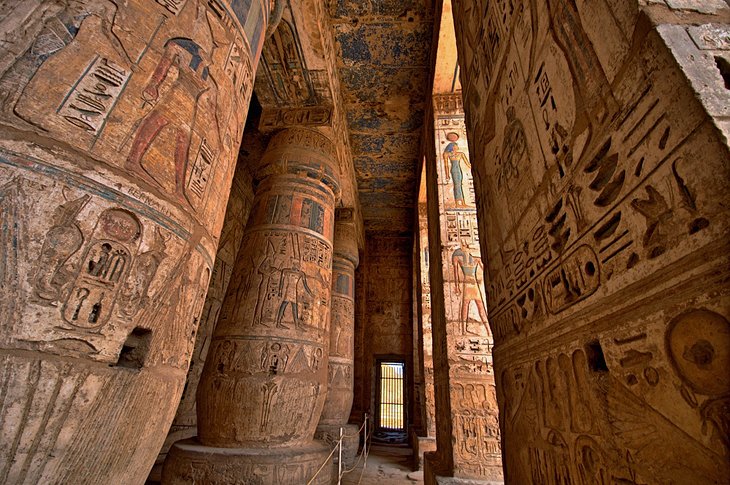
With the celebrated Valley of the Kings and Temple of Deir al-Bahri the primary attractions, Medinet Habu regularly gets ignored on a West Bank trip, yet this is one of Egypt's most wonderfully enhanced sanctuaries and ought to be on everybody's West Bank hit list. The unpredictable comprises of a little, more established sanctuary worked during the eighteenth administration and amplified in the Late Period, and the incomparable Temple of Ramses III, related with an illustrious royal residence, which was encircled by a battlemented nook divider four meters high.
The primary sanctuary zone was fabricated precisely on the model of the Ramesseum and, similar to the Ramesseum, was committed to Amun. The reliefs here are probably the best you'll see on the West Bank.


0 Comments